

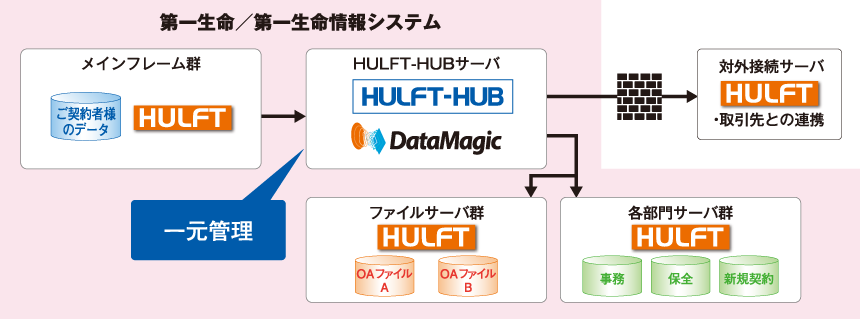
The Dai-ichi Life Insurance Company, one of Japan's leading life insurance companies with over 10 million individual customers, has adopted HULFT as the standard for file sharing between various systems deployed within the company and in transactions with external parties, and has built an internal file sharing infrastructure using HULFT-HUB. DataMagic is also used to achieve code conversion between mainframes and open systems, and the company has successfully integrated its previously separately built internal and external file sharing mechanisms with solutions from Saison Information Systems (now Saison Technology).
By utilizing HULFT, secure file sharing has become a matter of course.
This is a major benefit of the introduction.
By centralizing management with HULFT-HUB, we have been able to improve the efficiency of various tasks, including the investigation of detailed records.
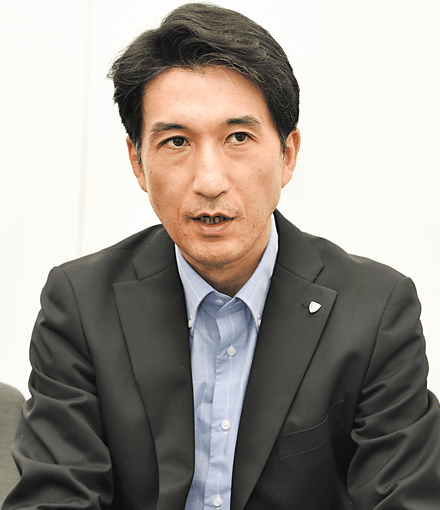
IT Business Process Planning Department
Deputy Director, IT Operations Management Division
Mr. Eita Yoshitome
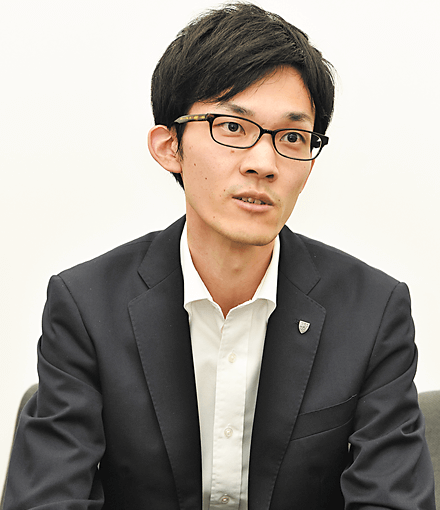
Infrastructure Systems Department 1
Infrastructure Development Group 2
Leader in charge
Mr. Tatsuya Takano
Customer Issues
We want to standardize file sharing mechanisms within the company and build a secure and flexible infrastructure.
Benefits of implementation

Safe and flexible
File Linkage
Realization of

Data accumulation and
Logs, etc.
Centralized management

Large capacity
file transfer
Building the environment
File sharing platform centered on HULFT-HUB
- Download the case study leaflet
- Download "80 Selected HULFT Use Cases" - a collection of use cases for HULFT, DataSpider, etc.
The Dai-ichi Life Insurance Company, Limited / Dai-ichi Life Information Systems Co., Ltd.
Founded in 1902 as Japan's first "mutual insurance company," the Dai-ichi Life Group's management philosophy of "customer first" has been ingrained in each and every employee and permeates every aspect of the business for over 115 years since its founding. Dai-ichi Life Information Systems is responsible for the Dai-ichi Life Group's IT strategy, developing and operating numerous systems that support a wide range of insurance operations from both the perspectives of "system solutions" and "administrative services."
- The content of this case study is current as of the time of the interview. The content of this case study may change without notice.