

DENSO Corporation, a global automotive parts manufacturer, has launched a project to rebuild its mission-critical business systems globally to enable smooth business collaboration between its bases around the world. As part of this project, they considered a data storage and exchange service as data integration platform. By utilizing DataSpider International, they have succeeded in establishing a platform that allows for flexible collaboration without having to be conscious of the partner.
Customer Issues
The challenge is to develop data integration platform that will enable the creation of a system that can respond to the globalization of business while utilizing the production management systems that have been individually established in each region.
solution
DataSpider International was adopted because it allows for effortless integration with both new and old systems, and because the company was committed to creating an agentless environment.
Benefits of implementation

Data accumulation/
Exchange service
Global use

data integration development
Productivity improvement
Strengthening governance

Legacy systems
Can be linked
Wide range of adapters
Background: data integration platform became an issue in building a global system
DENSO Corporation operates globally as a Tier 1 supplier of automotive parts directly to automakers. It handles many systems essential to automobiles, focusing on the fields of electrification, advanced safety/autonomous driving, and connected cars, while also focusing on non-automotive businesses such as factory automation and agricultural industrialization.
The company, which has 211 consolidated subsidiaries operating in 35 countries and regions around the world, is actively promoting globalization in the areas of management, human resources, research and development, and manufacturing.
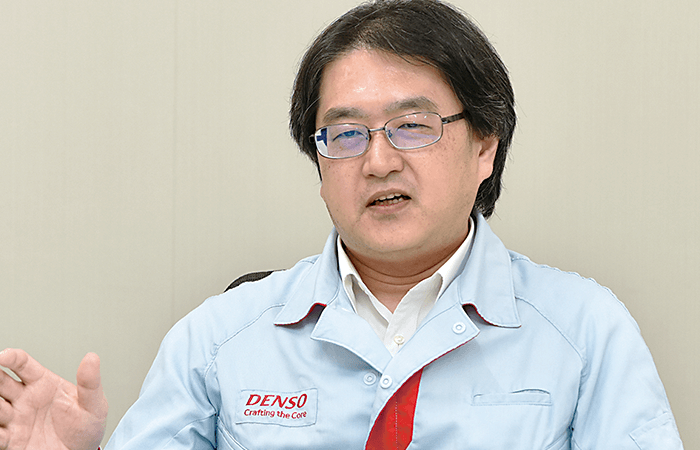
Mr. Tsuyoshi Nakayama, Section Chief, Information Systems Department
In the late 2000s, a project to globally rebuild mission-critical business systems in various fields began. In order to build a system that could respond to the globalization of business, a cross-organizational team was established to tackle various challenges. One issue that became apparent during this project was the establishment of data integration platform to seamlessly link information that had been exchanged separately in each region. "For example, production management systems were set up in each region and operated in a partially optimized manner, so it was difficult to integrate everything in an environment like the cloud, and it was more realistic to operate them locally. The challenge was to data integration between each region while making use of the existing production management system," recalls Tsuyoshi Nakayama, section manager of the Digitalization Promotion Office in the Information Systems Department.
DataSpider is loosely coupled and agentless, allowing for effortless deployment.
The company required a "loosely coupled" system that would allow flexible collaboration without affecting either the sending or receiving systems. Taking future scalability into consideration, the company also wanted a system that would enable data integration without the need to install agents in each regional environment. The company was determined to create an environment that would allow flexible collaboration not only with existing environments, but also with any new systems that might emerge in the future.
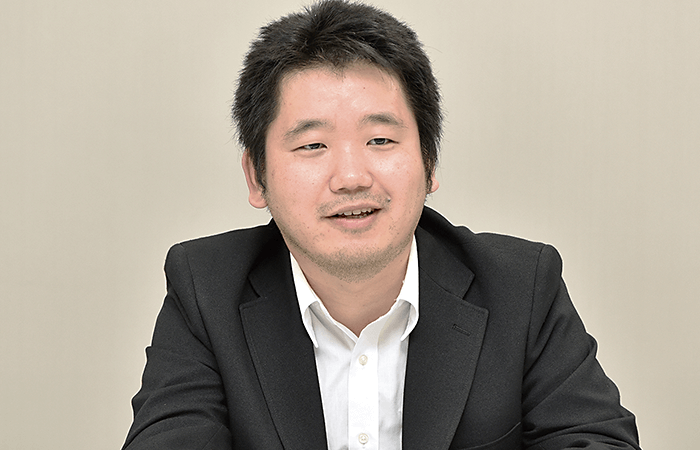
Mr. Hidenori Fukui, Section Chief, Information Systems Department
That's when they turned their attention to DataSpider International (hereinafter referred to as DataSpider), offered by Saison Information Systems (now Saison Technology). "At first, we considered an ESB-type system that connects applications via a bus, but from the perspective of loose coupling, we thought an EAI-type solution with a hub-and-spoke architecture that minimizes the impact on the connected device was the best option. Of these, DataSpider had a wide range of adapters and offered excellent cost performance," says Nakayama. Ease of data integration was also a key factor in their selection. "Various processes can be implemented simply by arranging icons without coding. With the aim of improving development productivity also in mind, we decided that DataSpider was the best option," says Fukui Hidenori, section manager of the Digitalization Promotion Office in the Information Systems Department.
With EAI, rather than a full mesh configuration where each region is directly connected to another, EAI acts as a hub and links in a one-to-many environment, but each time the number of partners increases, a script needs to be created. The fact that the system is simple to implement, with operational aspects firmly in mind from the planning and development stage, was highly praised.
HULFT, file transfer tool provided by Saison Information Systems (now Saison Technology), has been in use in Japan for over 20 years and continues to be used today. Saison Information Systems (now Saison Technology) is known for its stable operation and high-quality products, and as a result, DataSpider was chosen as the foundation for a data storage and exchange service that flexibly links regions.
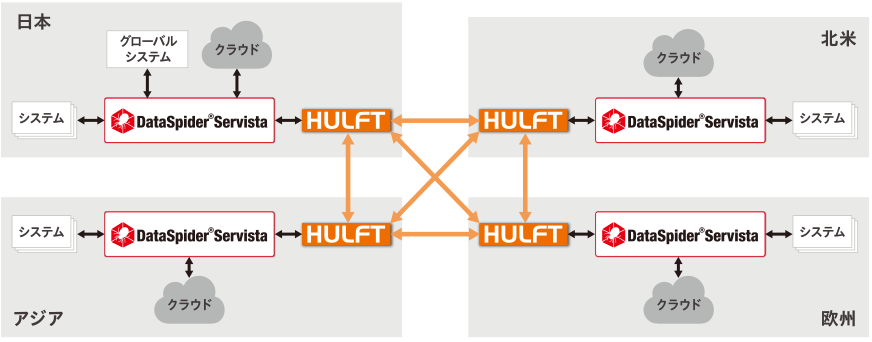
Data storage and exchange service configuration diagram using DataSpider and HULFT
Strengthening effectiveness governance while achieving flexible data integration with other regions
Currently, data storage and exchange services are being rolled out globally, with data storage and exchange servers used in Japan, North America, and Asia-Oceania installed on IaaS, and data integration is carried out via the group's internal WAN. DataSpider is used for data integration within each region, and HULFT is also used in combination. The timing of data integration varies depending on the application, with some cases requiring once a day being sufficient, and for accounting and other processes, data exchange may be required once every 30 minutes. Data storage and exchange servers are currently being rolled out in China, and future expansion to Europe is also being considered.
By utilizing DataSpider, data integration is now possible without having to consider the system of the other party, and by providing development guidelines and integration templates, individual implementation has been successfully minimized, enabling flexible data integration with other regions.
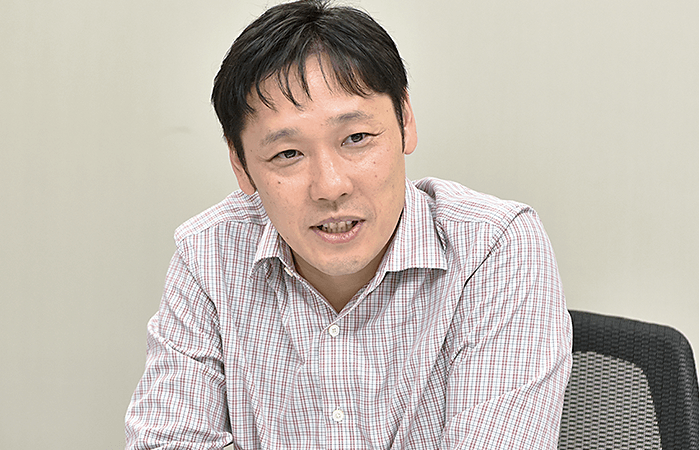
Mr. Hidenobu Yoshimura, Group Leader, Systems Development Division
"While improving productivity in the development of data integration, it has also led to strengthened governance," says Hidenobu Yoshimura, group leader of the System Development Division at DENSO IT Solutions Co., Ltd. In fact, by involving the operation staff in each region from the initial planning stage and going through a process of convincing them, including the parts of their work that would change, the system is being used successfully in each region.
They appreciate that DataSpider's internal mechanisms are not left behind, as it comes with a wide range of adapters for legacy systems such as Notes, and that its powerful mapping functions come in handy when it comes to meeting the numerous format conversion needs of systems in various fields.
NTT Technocross Corporation handled the system from the planning stage through to operational support. "They selected DataSpider with us and provided solid support when we expanded overseas. They even responded to our difficult requests, which allowed the expansion to go smoothly, and we are grateful for that," says Fukui.
Regarding the future, Yoshimura said, "As a manufacturing company, it is entirely possible that we will be required to respond to things like IoT in the future. We would like to work on creating an environment that takes this into consideration as well." Nakayama added, "We would like to further expand the data accumulation and exchange service using DataSpider that we have built this time, and create a system that will enable us to demonstrate synergy within the group by promoting data utilization globally."
- Download the case study leaflet
- Download "80 Selected HULFT Use Cases" - a collection of use cases for HULFT, DataSpider, etc.
DENSO Corporation
As a global company that supplies automotive parts directly to automakers, the company has 211 consolidated subsidiaries operating in 35 countries and regions around the world. The company handles many systems essential to automobiles, including thermal systems related to heat management, powertrain systems, electrification systems, and mobility systems. While focusing on the fields of electrification, advanced safety/autonomous driving, and connected cars, the company is also focusing on non-automotive businesses such as factory automation and agricultural industrialization.
Sales partner: NTT Technocross Corporation
- The content of this case study is current as of the time of the interview. The content of this case study may change without notice.