


Jeco Corporation (hereinafter referred to as Jeco) has been developing, designing and manufacturing various automotive parts for over 60 years since its founding. Based on its management philosophy of "Continuing to challenge the basics, creativity and growth," the company responds quickly and flexibly to the needs of the automotive industry, which is experiencing major paradigm shifts such as electrification and autonomous driving, and provides products with new value. The company is highly trusted by customers and highly regarded for its "manufacturing capabilities."
The company embarked on a major system reform. They aimed to move away from a reliance on Excel and create an environment where they could smoothly check the necessary data using BI tools. This would allow them to spend time on essential tasks such as analyzing, considering, and taking action based on the collected data, rather than wasting time on "collecting data." This project produced great results by proactively incorporating the latest technologies such as RPA and IoT to automate data collection and processing. The trigger was the migration of the host computer.
Customer Issues
Even if we try to process the data obtained from the parent company's host (mission-critical system, core system), it is too large and fixed length to process.
Benefits of implementation

By combining DataMagic with BI tools, sales data can be displayed graphically and drill-down is also possible.

All data processing is done using DataMagic, which can be implemented without programming, making handover easy.

Automating attendance management in accordance with the Work Style Reform Act reduces work time by more than 80%
How to process 300 types of fixed-length data
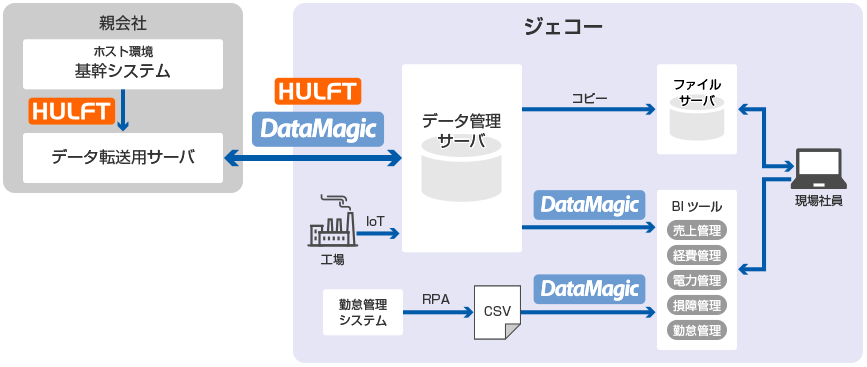
Jeco, a manufacturer of automotive parts, had been running mission-critical system, core system on its own host computer for many years. However, securing engineers familiar with hosts and COBOL was difficult, and the company could no longer continue to maintain this system. Two years ago, the company decided to completely migrate mission-critical system, core system to a system provided by its parent company. Shiota, who was in charge of information systems at the time, recalls, "Looking back, this decision was the first step in business reform." "mission-critical system, core system running on the parent company's host was used by multiple group companies, so it didn't provide the functionality tailored to our business operations and needs. Previously, the information systems department would develop and provide the necessary data whenever a request was made from the field. If this were no longer possible, it would have an impact on field operations." So Shiota decided to have all the data managed by the parent company's mission-critical system, core system provided, process it in-house, and provide it according to the field's needs. However, "the data amounted to approximately 300 types, and was sent in fixed-length data using unique terminology. Moreover, the volume of data sent each time was so large that it was impossible to process it in Excel." Naturally, this data sent daily needed to be accumulated. Furthermore, rather than storing the data as is, they wanted to manage it in a state where it was organized by product number, etc. "At first, I thought about using an existing database application, but the program ended up being quite complicated and the processing was slow, so it was useless." Just when they were at their wit's end, they came across "DataMagic."
Data processing is simple, highly accurate, and fast
DataMagic was introduced at a seminar attended to deepen knowledge about using HULFT for data transfer with the parent company's host environment. "DataMagic is similar to the host's way of thinking, so we were able to easily split fixed-length data. What's more, specifications are generated automatically, so handover is easy. When we actually used it, we found that it was highly accurate and processed quickly. Being able to process large amounts of data quickly is a major advantage, especially since we need to process large amounts of data every day, and we were convinced that this would be fine (Mr. Shiota)." Furthermore, trigger settings, such as executing processing when data is saved in a target folder, can be completed simply by setting a checkbox in HULFT. Data merging and field combinations were also easily configured and perfectly achieved.
Another thing that he highly values about HULFT and DataMagic is the support. He uses 24/7/365 Support Service, and says he is satisfied with the quick response whenever he calls. "Although it is more expensive than regular support, since we run mission-critical system, core system, the peace of mind of knowing that we have support 24 hours a day is invaluable. We need to send data in time for the 'night delivery' that is sent between 8:00 and 9:00 PM, so it is extremely helpful to have support over the phone when we have any problems."
Combining DataMagic with BI tools to achieve the ideal
With the support of Otsuka Shokai, the company introduced DataMagic and also introduced the BI tool "Qlik Sense." "Until now, we had managed everything, including sales, in Excel, and we had to repeat the same work every time we had a board meeting to create report materials. What's more, when we reported, we would be asked, 'What are the details of these numbers?' and we would have to search for another Excel spreadsheet," says Shiota. This was extremely inefficient. Utilizing a BI tool makes it possible to display data graphically and perform drill-down analysis.
By processing data obtained from mission-critical system, core system and other sources with DataMagic and importing it into BI tools, sales management, expense management, and power management are realized. IoT is also being used to manage losses (defective products on the production line). "Until now, loss management involved manually counting boxes of defective products. Using DataMagic and BI tools, we've made it easy to check this based on error data from inspection machines and other sources (Mr. Shiota)." Recording of loss expenses has also become more accurate, and it is now clear at a glance which lines and which products are experiencing increased losses. This not only leads to more precise countermeasures, but also makes it possible to verify the effectiveness of the countermeasures. It is said that this has also brought about major changes in on-site operations.
The next project was "IT reform of human resources."
The Work Style Reform Act came into effect, setting limits on overtime work and paid vacation. Since violations carry fines, this became a major issue at the board of directors meeting, and the parent company also issued a notice to strictly adhere to the rules. "I think this should be handled by the attendance management system, but the vendor told us that the version we're currently using won't be able to support it," says Shiota. Just because the system doesn't support it doesn't mean we have to manage it. That said, there are limitations to managing overtime hours in Excel. Until now, on-site managers have managed it in Excel, but in some departments, it becomes necessary to manage overtime hours for up to 100 people. "Basically, section chiefs compiled their subordinates' attendance records into Excel and submitted them to their superiors, but this compilation took an hour every day, which was a major burden. It was a problem that so much time was being spent on labor management, when production sites should be thinking about things like product quality," says Shiota.
While searching for a solution, Shiota realized that this could also be achieved by combining DataMagic with a BI tool based on data from the attendance system. He immediately began displaying monthly and annual overtime hours for each employee to ensure that the overtime limit based on the Article 36 Agreement was not exceeded. Furthermore, to comply with the regulation that "the average for multiple months must not exceed 80 hours," the system also supported the display of average overtime hours for multiple months. "Calculating the average for multiple months requires fairly complex program development if it were implemented entirely on the BI tool side. So we created a flow where DataMagic calculates the average and then displays the results in the BI tool," says Shiota. This made it possible to maintain ease of handover while creating an environment where the necessary information could be grasped at a glance. "The color changes depending on the overtime status - blue, yellow, red. Yellow means caution, red means no more overtime can be worked," says Shiota. "Now you can understand the status of your subordinates at a glance."
RPA is used to retrieve data from the attendance system. "We weren't able to automatically output it from the system, but our goal was to have all the data ready by 9am every morning, so we wanted to avoid doing it manually," says Shiota, who set his sights on RPA. They then introduced the RPA tool "WinActor" and created a system that allowed them to easily automate everything. By proactively utilizing new technologies and tools, they are able to minimize manual work and maintain an environment that is not dependent on individual skills.
Reduce attendance management work in Excel by over 80%
The effects of the introduction have also been significant. The work of managing attendance, which used to take 1,920 hours per year, has been reduced to just 320 hours, a reduction of more than 80%. Shiota says, "We no longer need to compile data; we just come into the office in the morning and look at the screen, which has been very well received by our employees." Not only can we focus on dealing with people who haven't taken enough vacation time or who work a lot of overtime, but the BI tool also displays the information graphically, making it easy to communicate to our subordinates. "When it comes to audits by the Labor Standards Inspection Office, simply saying 'we have the data' is not convincing, but by showing a system like this, we can prove that we are managing things properly," says Shiota.
From now on, what will be important is what to think about based on the collected data and how to utilize it. RPA, IoT, BI, and DataMagic, which prepares the data to link them... These have enabled the company to move away from a situation where time was wasted on collecting and processing data, and to successfully shift course to an environment where data utilization can be started first. "Recently, we have been receiving requests from the field asking, 'Can we make this viewable with BI tools as well?'" What kind of future does the company envision now that it has achieved an environment where it can fully utilize data?
Jeco Co., Ltd.
The company handles a wide range of products, including automotive clocks, automotive instruments, axle motors, and application products. In addition to monitors and sensors, the company's strengths lie in display products such as clocks, multi-displays, and air conditioning panels. As the automobile society undergoes major changes, the company continues to take on the challenge of becoming a company that creates new value through products that provide safety and comfort, and environmentally friendly, energy-saving parts.
Hiroshi Shiota, Human Resources Group Leader, General Affairs and Human Resources Department, Jeco Corporation
Sales partner: Otsuka Shokai Co., Ltd.
- The content of this case study is current as of the time of the interview. The content of this case study may change without notice.