

Minamiide Kikai is a specialized trading company headquartered in Osaka that provides products related to "water, wind, and heat" to factories and manufacturing sites across the country. They boast a top-class trading record in Japan for ventilation fans, blowers, and especially fluid pumps.
"We were suffering from a labor shortage. As a way to solve this problem, we first considered automating the processing of orders received by phone and fax, and received a proposal from Otsuka Shokai," says the company's Managing Director, Takeaki Yoshida. This time, we spoke with Assistant Manager Eiji Uchida and Masanobu Hiraoka of the IT Promotion Office, who led the renewal of the company's internal IT system together with Managing Director Yoshida, about the trading company's problems and how they were resolved.
Customer Issues
We want to automate the manual order entry and management processes, improve operational efficiency, and create a system that can respond to customers quickly and accurately.
Benefits of implementation

600 hours per year
Expected reduction in man-hours

Human error
reduction

In 3 months
data integration platform construction
The problems faced by Minamide Kikai, a company that supports manufacturing sites
Minamiide Kikai is a wholesale trading company with an 80-year history, founded in 1939. They specialize in equipment that circulates, sends, heats, and cools water and air, and have bases in 17 locations across the country. The pumps and blowers that the company handles are often installed when factories are built, or when production facilities are introduced or expanded.
"Factories and other manufacturing sites are located all over the country. Sometimes new sites are set up, and sometimes equipment breaks down over time. We often receive consultations and are asked for estimates, but processing estimates and purchase orders was almost always done manually," says Managing Director Yoshida.
In the industry, consultations and orders are still mainly made by telephone or fax. Handwritten order forms are sent by fax, and sales staff or assistants manually enter them into a database. The input data often contains a series of numbers and letters for parts, part numbers, and models, which can lead to input errors. "If there was no input work to begin with, there would be no hassle and no mistakes," continued Managing Director Yoshida.
"Of the 70 salespeople, about half were assistants in charge of data entry and order placement, but they spent a total of about 50 hours a day just entering orders, or more than 10,000 hours a year," said Assistant Manager Uchida.
"We were facing a labor shortage, and with work style reforms and other changes in the industry, we had been struggling for a long time with the question of how to secure labor. We thought that improving order entry could also help alleviate the labor shortage," says Managing Director Yoshida.
So they turned their attention to a specialized department that received most orders via Web-EDI from customers. This department, which does a lot of business with trading company clients, had a large number of orders, and inputting and checking them took a lot of time. Managing Director Yoshida thought that by automating the input and management of order forms, they could not only alleviate the labor shortage, but also put in place a system that would allow them to respond to customers quickly and accurately.
Transforming environments with multiple systems into "easy-to-use" environments
"When we reviewed our company's internal IT system, we found that it was a mixture of multiple tools and systems, and that many aspects were dependent on individual knowledge. In order to advance automation, we first needed to put the system in place and create an easy-to-use environment that anyone could operate and maintain," says Managing Director Yoshida.
In response to a request from Managing Director Yoshida, Assistant Manager Uchida of the IT Promotion Office began working towards automating order processing. Initially, he was looking for a tool that could link with each master data set and quickly convert EDI data. He consulted with Otsuka Shokai, with whom he had previously done business, and they suggested DataSpider International.
"When I participated in a hands-on seminar for DataSpider International, I was able to create linked processes using intuitive operations such as placing icons on the GUI screen. It was also very easy to understand because the operation of the entire system could be seen on a single screen. Hiraoka and I are the two of us in charge of all IT within the company, so we wanted to avoid creating and operating processes that were too complicated, and we felt this would work. Furthermore, as more and more internal systems are being moved to the cloud in the future, we felt it was reassuring that the wide range of adapters provided was included." (Assistant Manager Uchida)
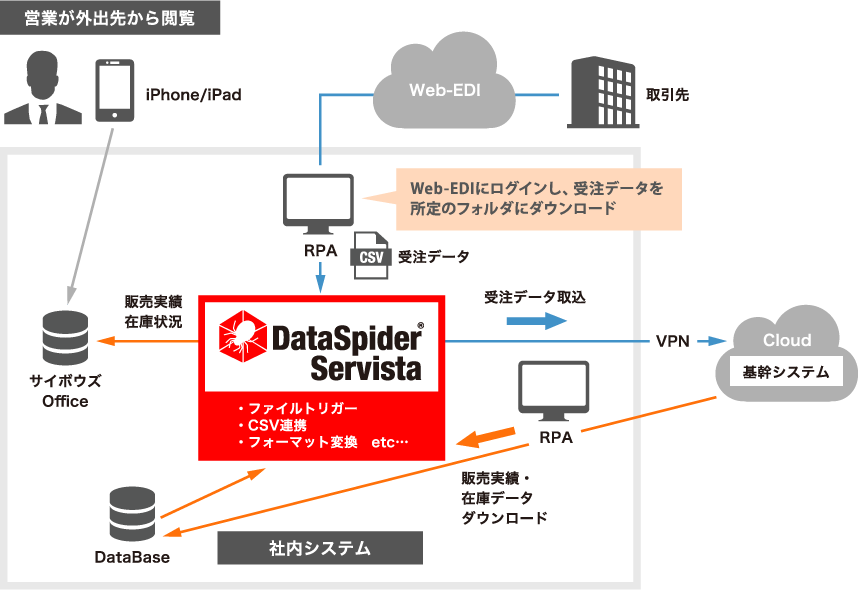
They quickly implemented the system, with Otsuka Shokai helping to set up the server, and in the fall of 2018 they imported the existing database and began full-scale operation. Data received via Web-EDI is automatically downloaded to a designated folder via RPA, where it is converted by DataSpider and linked to mission-critical system, core system. In addition, inventory information and performance values from mission-critical system, core system are linked to Cybozu Office via DataSpider International, allowing sales staff to view the data on their iPhones while on the go.
Automation reduces work by approximately 600 hours per year, allowing employees to focus on creating value
"We wanted to automate the process from EDI to linking data to mission-critical system, core system. DataSpider International can link many file formats and has a wide variety of triggers to execute processes, so we were able to set it up smoothly." (Assistant Manager Uchida)
Assistant Manager Uchida continued, "We only had three months" from selection to operation. Apparently, it all started with the question of "is there any way to replace, even just a little, the work of a veteran ordering clerk who was leaving the company?"

"We managed to set it up without changing the timing. However, there are some tasks that absolutely must be done by people, so it's difficult to replace 100%. But we were able to gain insight into what tasks can be replaced. As a result, we calculated that we could reduce approximately 600 hours per year in just the one department that introduced it. You can create invoices just by importing them without any input errors. This is a big deal."
"At first, it took some getting used to, but the functions you want to use are grouped together with icons, so you can select them visually. It's very easy to understand, and it saved us a lot of time compared to learning the system and language. Also, because you can set it up while seeing how it works on the system, I found it easy to debug." (Hiraoka)
In the future, they will communicate with their business partners about ordering and receiving via Web-EDI, and are also considering using the scanner's OCR function to import faxed orders in a paperless manner, convert them, and link them to mission-critical system, core system. "If we can do this, we can further reduce the amount of work that requires manual intervention," said Assistant Section Chief Uchida.
"Our information includes information on implementation results and other things. We can use this information in sales activities and make proactive sales proposals by analyzing data that was previously dependent on each sales representative, such as order timing. Work style reform is said to 'increase productivity.' We believe that it is not simply about 'reducing people's workload,' but about 'increasing the time people have to create value.' We would like to continue to promote work style reform through DataSpider International." (Yoshida, Managing Director)
Minamide Machinery Co., Ltd.
Founded in 1939, the company is a specialized trading company with approximately 160 employees that mainly handles industrial machinery. With the slogan "Contributing to society at large through water, wind, and heat," the company has 17 locations nationwide and handles a wide range of water, wind, and heat-related equipment, such as heaters and boilers, that are essential to manufacturing sites. In addition to providing maintenance services from equipment installation to maintenance inspections, the company also focuses on consulting at the time of installation and proposing solutions.
Sales partner: Otsuka Shokai Co., Ltd.
- The content of this case study is current as of the time of the interview. The content of this case study may change without notice.