

NEC Fielding, an NEC Group company, provides hardware maintenance services for computers, communications equipment, and other devices. Leveraging its nationwide network of bases and logistics, the company provides comprehensive support, including system integration and security, not just for NEC products but also for equipment from a wide range of manufacturers, including non-IT devices. As ICT becomes increasingly important, even more stable operation is required across the board, and flexible response is essential to improving CX (customer experience). To support these changes from a system perspective, the company decided to migrate its long-standing system to Salesforce, but data integration with other systems became a challenge. Therefore, they implemented DataSpider, creating a stable data infrastructure that supports critical systems that operate 24/7.
Customer Issues
We want to efficiently data integration points between Salesforce and existing systems.
Benefits of implementation

Salesforce
correspondence and efficiently
Implementing data integration
Easy-to-understand UI in
Implementation and obstacles
Easy to separate
Redundant configuration allows
Due to maintenance
Minimize outages
Moving to Salesforce for greater flexibility. Over 100 data integration become an issue
NEC Fielding has bases across the country and operates a business with hardware maintenance at its core. As the entire industry is forced to change, with factors such as a decrease in demand for hardware maintenance due to the shift to cloud computing, NEC Fielding does not simply provide maintenance for breakdowns, but leverages its strength in providing support close to the customers who actually use ICT to provide support that covers the entire ICT lifecycle.
The system used at the maintenance site, which operates 24 hours a day, 365 days a year, is an on-premise client-server system that was developed from scratch to suit the company's operations.
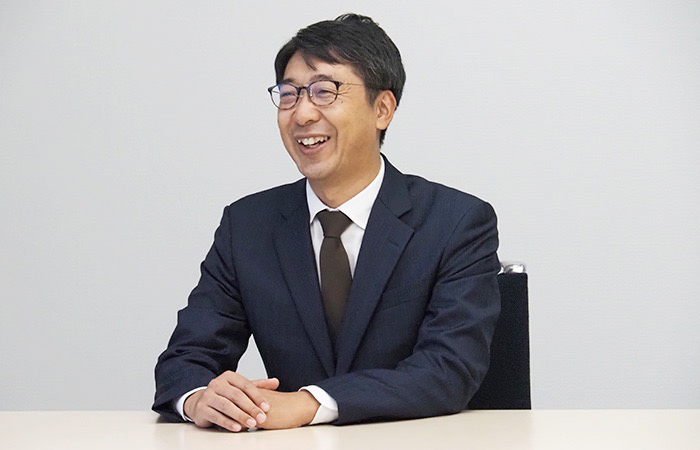
Jun Uechi
"It's been nearly 30 years since the system was launched, and the functions have become more complex, so we couldn't keep up with the modifications and maintenance. There were also some issues from the perspective of data governance, so we decided to migrate to Salesforce," says Uechi.
Of the many systems, the first thing they decided to migrate was the maintenance reception (contact center) system and maintenance work system, which are the core of maintenance operations. These systems share data with other systems, such as parts inventory requests, and data integration will remain essential even after migrating to the cloud. "If you count the small details, such as obtaining parts information, updating inventory information, and sharing work information, you'll need more than 100 interfaces. We'll use the migration as an opportunity to consolidate and eliminate some systems, but because the volume is so large, the challenge was how to share the data," says Higuchi.
DataSpider can support on-site operations 24 hours a day, 365 days a year
One option was to use data integration platform that had been used between existing systems, but it would have to be built to be compatible with Salesforce. "There are restrictions specific to Salesforce, such as governor limits*, and we felt that investigating and addressing each one would be too much of a burden. Since we were aiming for a short migration period, we thought it would be unrealistic to build it ourselves from scratch, so we decided to look into tools that had a proven track record of integration with Salesforce," says Ishikawa.
Mr. Kiyomichi Ishikawa
Several tools were considered, but it was difficult to find one that met their requirements, such as "there is no track record of supporting Salesforce in Japan" and "it does not fit the scale of our company's environment and would exceed our budget." DataSpider met all of these requirements. The fact that it was handled by NEC also helped, and the decision to implement it went smoothly. "We also considered DataSpider Cloud, but since NEC Fielding claims to provide 24/7 support, we cannot stop the system. Planned shutdowns are also difficult, and the inability to control the timing of maintenance with the cloud was a problem, so we decided to implement the on-premise version," says Ishikawa.
- Limits to prevent uneven resource usage. If the limit on the number of SQL queries or API requests is exceeded, the resource will be unavailable for a certain period of time.
Data movement is "understandable at a glance," and the implementation is efficient, leading to a successful release.
"DataSpider is visual, so I think it's very easy to understand. When reviewing whether the implementation has been carried out as designed, it's easy to see how the data is moving and linked to Salesforce, and it has also become easier to isolate the cause of any problems (Higuchi)." Because the settings are basically done using a GUI, there is no room for coding mistakes, and it is difficult for individual team members to adopt their own habits.
Mr. Shota Higuchi
The advantage is that it minimizes the risk of problems occurring during implementation. "Because we didn't have anyone with experience, we had to fumble around trying to figure out how to set things up, but the quick response to our inquiries was very helpful," said Higuchi.
Implementation is proceeding as planned, with the help desk area being released as Step 1 in 2021. This will be followed by Step 2, the customer call center maintenance reception system and dispatch function (maintenance staff dispatch area), in 2023, and the application (work area) used by engineers working in the field in December 2024, completing the transition.
Shorten maintenance time...DataSpider duplication
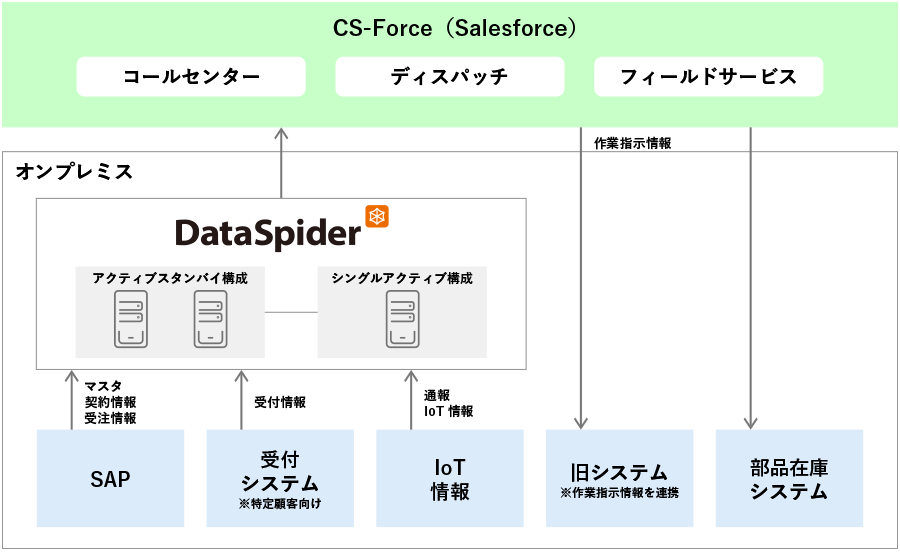
One problem that arose during the release process was system outages during maintenance. When DataSpider was first deployed, it was deployed in an active-standby configuration, but this inevitably meant that system outages were required for each release. Salesforce releases new features in three version upgrades per year, and to utilize these, DataSpider also needs to be upgraded. Upgrading DataSpider requires uninstallation and reinstallation, so system outages are unavoidable. "When we notify the company that the system will be outages due to maintenance, we also hear from the field, 'Please don't stop it so frequently.' Although we can control the timing of maintenance, our true desire is to avoid system outages as much as possible in order to provide support 24 hours a day, 365 days a year," says Ishikawa.
So they added a single active system to the existing configuration, and although they could not perform maintenance without interruption, they were able to create an environment where releases could be made with minimal system downtime. "Shortening downtime reduces the impact on the site, so we believe that this will lower the hurdle for releases and allow us to improve functionality more frequently," says Ishikawa.
High stability for mission-critical applications
There have been no problems with DataSpider and it is running stably. "I had a strong impression that it was a tool that boasted high flexibility, but I realized that it can be used safely even for mission-critical purposes," says Uechi.
By migrating to Salesforce, they have been able to move away from on-premise operations, and in the future it will be much easier to add features that will lead to business expansion. They are also planning to use generative AI to summarize call centre inquiries. "With this migration, we are now able to make use of the data collected in Salesforce. However, as this is limited to simple data analysis, we plan to build a separate data analysis platform for detailed analysis and storage of old data. We hope to be able to use DataSpider here as well," says Uechi.
NEC Fielding, Ltd.
As a member of the NEC Group, we provide maintenance support for a variety of devices and systems, including hardware, software, and networks. In addition to NEC products, we also handle products from manufacturers other than NEC and non-ICT equipment. We also provide total support for the ICT lifecycle, from device installation and construction to operation and security.
- The content of this case study is current as of the time of the interview. The content of this case study may change without notice.