

Founded in 1953, Nikkiso Co., Ltd. (hereinafter referred to as Nikkiso) manufactures industrial special pumps, CFRP (carbon fiber reinforced plastic) aircraft parts, hemodialysis medical equipment, and other products, focusing on the three fields of industry, medicine, and aviation. Leveraging its strength in advanced technological capabilities, the company has produced many products that are the first of their kind in the world or Japan, and recently began selling "Aeropure," an air sterilization and deodorization device that uses deep ultraviolet LEDs for sterilization and air purification, attracting a great deal of attention. In the aviation business, the company continues to take on new challenges, such as starting joint development with Airbus.
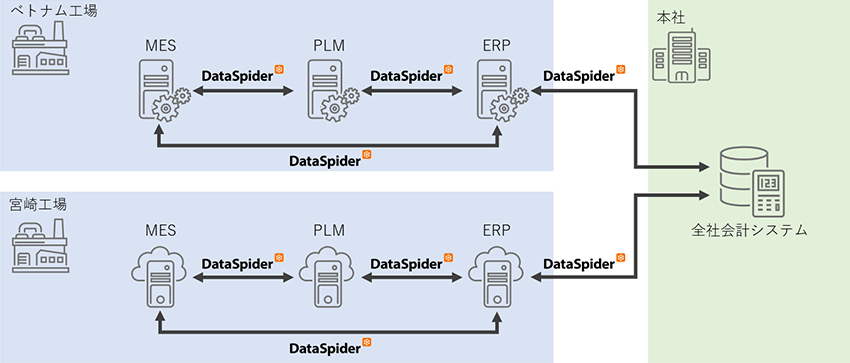
The company's Aerospace Business Headquarters, which is expanding globally by establishing a factory in Vietnam and aiming for further business expansion, has newly implemented ERP/PLM (Product Lifecycle Management)/MES (Manufacturing Execution System) at multiple factories to promote factory digitalization and operational efficiency. By utilizing DataSpider International (hereinafter referred to as DataSpider) for linking between systems and with existing mission-critical system, core system, the company was able to develop the system in a short period of time and achieve an environment that can be operated efficiently. We spoke to the company, which aims to further improve its technical capabilities and quality through systemization and data utilization.
Customer Issues
There are many connections required to link multiple locations and systems, and we want to implement data integration with a view to centralized operation.
Benefits of implementation

With DataSpider,
Implementing data integration
Standardization/commonization

The operation is easy
Easy to understand,
Rapid development
It is possible to

Even after the system is operational
Can be operated centrally
data integration platform
realization
In order to accommodate business expansion, systems at multiple factories were updated.
Nikkiso has earned a high reputation for its technological strengths in industries that require specialization, such as industrial, medical, and aviation. While working on products where "what if" is not an option, the company has a thorough commitment to quality and technology, and continues to meet customer expectations.
The company's Aerospace Business Division operates factories in Vietnam, Miyazaki, and elsewhere, and decided to implement a new system to advance digitalization and improve operational efficiency at each factory. Mr. Yasui of the Global Information Management Department explains, "Until now, we've been implementing small packaged products individually and using Excel, but we weren't able to data integration between them. To accommodate the expansion of our business, we decided to implement new ERP/PLM/MES systems at each factory and revamp our environment." data integration between systems is essential, but three systems must be installed at each factory, interconnected, and then linked to the SAP accounting system used company-wide. "From a development perspective, once you develop an interface for each system, you can deploy it to each location by simply configuring the connection. However, subsequent operation requires monitoring the connection status and ensuring there are no problems at each location and system. Managing these systems individually isn't realistic, so we considered implementing a tool that could be used as data integration platform," says Mr. Yasui.
The policy is to minimize customization and development. data integration is also standardized and standardized using DataSpider.
Tetsuji Anzai, Global Information Management Department
Among these, DataSpider emerged as a candidate. The company had previously used DataSpider's functions to data integration between SAP and peripheral systems, and highly praised its ease of use. "The functions are simple, and it specializes in exchanging data and files and mapping items, so all you need to do is set up which files and databases to connect, which items to connect, and how to convert them. Another attractive feature was the wide range of connection adapters," says Yasui. Another major benefit was that it was possible to use the system by simply building the DataSpider server, without the need for separate components such as Java or an FTP server. "The impression was that it minimized the burden on both development and operation, and we were confident that using DataSpider would also be sufficient for this system integration, which led to a smooth decision to implement it," says Yasui.
Originally, the company's policy regarding system implementation was to use the standard functions of the package as much as possible, with customization kept to a minimum. In this project, they also wanted to avoid developing data integration one by one, and instead utilize tools to standardize it. "If you develop data integration from scratch, the implementation method will differ depending on the person in charge, and the maintenance burden will increase. With DataSpider, you can create templates for basic processing, which will unify the implementation method and lead to standardization and commonization of processing," says Yasui.
The first stage of the project involved implementing eight interfaces using DataSpider to data integration between the MES and existing systems. One person completed the work in just three months. "Because the members had experience using DataSpider with existing systems, the basic design was completed smoothly without any issues. As it was a tool that we were familiar with, we were able to get a concrete idea of how long it would take to develop, which gave us peace of mind," says Yasui.
By centralizing operations, we have created a foundation for promoting data utilization
There are also high expectations for DataSpider in terms of improving operational efficiency. "DataSpider's logs are easy to read, and it shows where the problem is occurring on the same screen as during development. The details of the error are also intuitive, so I felt it would make operations easier. In cases like this, where multiple systems at multiple locations need to be individually connected and there are many points of contact, I think the benefit of being able to centralize operations is great," says Yasui.
Initially, the system was scheduled to be introduced at the Vietnam factory in spring 2020, but this was postponed due to the spread of COVID-19. The company is currently aiming to introduce the system at the Miyazaki factory.
Yasui also says that he would like to further promote the use of data in the future. "Until now, some operations were handled on paper, but with this project we have been able to fully systematize them. However, introducing the system is not the goal; it is merely the first step in advancing digital transformation. We will now consider how the system can contribute to further improving the quality of each product, and how we can acquire, store, and utilize data to achieve this," he says.
Nikkiso Co., Ltd.
The company manufactures and develops industrial special pumps and systems, medical equipment, aircraft parts, etc., and boasts a high market share in each industrial field thanks to its overwhelming technological capabilities and quality. In particular, Cascade, which has a global market share of over 90%, is an essential component in aircraft thrust reversers, and its value has been recognized. In June 2020, the company was selected as one of the "100 New Global Niche Top Companies Certified by the Ministry of Economy, Trade and Industry."
Sales partner: Hitachi Systems, Ltd.
- The content of this case study is current as of the time of the interview. The content of this case study may change without notice.