

Nissin Foods Holdings Co., Ltd., which is creating a new food culture with innovative technologies and ideas, is promoting business transformation using digital technology to achieve the goals set forth in the Medium- to Long-Term Growth Strategy 2030, and is working on five measures, including cybersecurity. One of them, "Developing a platform that contributes to data-driven" management, is to develop an data integration /analysis platform. As a data integration platform to aggregate data from each partially optimized system and feed it into DWH, the HULFT Square of a cloud-based data integration platform (iPaaS) is utilized.
Customer Issues
We want to consolidate data from partially optimized systems and establish a foundation that contributes to data-driven management.
Benefits of implementation

Utilizing data
To activate
data integration /
Analysis infrastructure development
Contributing to

Data acquisition work
Approximately 60% reduction
Data Utilization
Process efficiency
Contributing to

By data
Beyond organizational boundaries
collaboration
activity Cultivating
Background: Promoting a project to establish a foundation for data-driven management
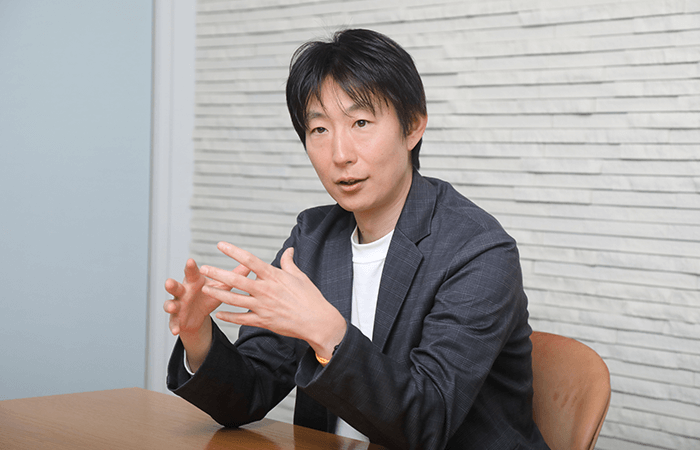
Head of Data Science Office, Information Planning Department
Mr. Yoshihiko Itagaki
Nissin Foods Group is an "EARTH FOOD CREATOR" that is constantly creating new food cultures, pursuing the possibilities of "food" and aiming to solve social issues and contribute to the earth through the enjoyment and joy of "food." Based on the spirit of its founder, Momofuku Ando, who invented instant noodles such as "Chicken Ramen" and "Cup Noodles," the group's philosophy, the group is now a comprehensive food group that not only operates instant noodles, but also operates non-instant noodle businesses such as chilled noodles, frozen noodles, beverages, and confectionery on a global scale.
In 2019, the group adopted the company-wide slogan "DIGITIZE YOUR ARMS," and has since been using digital technology to implement various measures, including moving away from paper culture and promoting telework.
In 2022, Nissin Foods Holdings Co., Ltd. established five key digital initiatives with an eye toward 2030: cybersecurity, global IT governance, digital support for business divisions, utilization of advanced networks and mobile devices, and the establishment of a foundation for data-driven management. The Data Science Office of the Information Planning Department at Nissin Foods Holdings Co., Ltd. is currently working on establishing a foundation for data-driven management. "We are working to establish a data integration and analysis platform so that we can get to the starting line as a data-driven company before 2025. Specifically, we are promoting three activities: consolidating various data sources in one location, distributing it to business divisions for use in their work, and increasing the number of IT-savvy employees by improving their IT literacy," explains Yoshihiko Itagaki, head of the Data Science Office.
To develop the data integration and analysis infrastructure that is essential for data-driven management, it was essential to create a system for collecting data that was scattered across each business process. "In order to utilize data for decision-making, it is necessary to cross-reference various data and optimize the entire process," says Kazuyoshi Yamagata, a professional in the same department. At the company, major business processes include "planning" for sales and production, "shipping" of products, "delivery" to wholesalers and retailers, and "sales" centered on POS data in stores, and these are operated on individually optimized systems. Therefore, in order to expand data utilization throughout the company, the company decided to start creating an environment for collecting this data and consolidating it into a single DWH.
Effectively wrapping the technology of data integration, with a proven track record in data integration
Evaluating HULFT Square
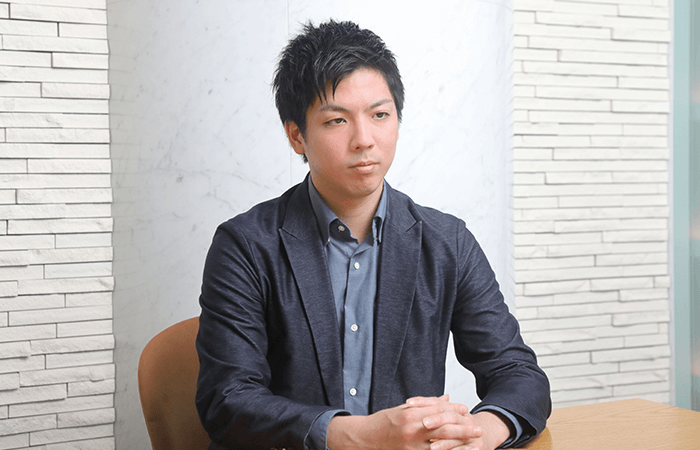
Information Planning Department Data Science Office Professional
Mr. Kazuyoshi Yamagata
As a company that has a cloud-first approach, one of the data integration methods that caught the company's attention was iPaaS, which allows data from multiple systems to be integrated on the cloud. "One of the keywords was being able to integrate with one technology, product, and service. We also needed something with a wide range of connectors for external integration so that even a business company like us could implement development," says Yamagata.
Then, while comprehensively considering a DWH as a data aggregation box and an iPaaS as a pipeline for data integration, the company set its sights on HULFT Square, a data integration platform provided by Saison Technology. "We had a track record of using HULFT internally for file transfer, and we knew it was a service that guaranteed a certain level of quality in terms of data integration.
"It had a wide range of connectors, so we felt we could trust it," says Itagaki. He also adds that it was important that it had the technical capabilities to link with Snowflake, which they were considering introducing as their DWH.
Another attractive feature was that the functions required for data integration were neatly packaged as a service. "The fields of data science and data analysis require a lot of knowledge, from IT infrastructure to the ability to communicate with business departments, and it has a strong mixed martial arts aspect to it. To be honest, it's difficult for members who are skilled in analysis to catch up with the IT infrastructure field, but HULFT Square has neatly packaged the technology. Not only does the GUI make it easy to visualize processing, but development can be done without coding. The low barrier to entry was a big factor," says Yamagata.
In particular, for the Data Science Department, which aims to train new employees by providing them with opportunities across a wide range of phases, from dialogue with business departments to development and subsequent improvement activities, it is difficult for new employees to master all of the necessary skills. Therefore, it is expected that HULFT Square will be useful in narrowing down the areas that need attention and creating an environment where employees can quickly become valuable assets.
The organization's goal is to create an environment where it can in-house everything from designing the data infrastructure to conceiving the concept after grasping the technical points, and they also praised the company for its ability to be self-sufficient. "We wanted to work on the project with a company that understood our philosophy and could accompany us. In that respect, we highly evaluated Saison Technology as a partner, not only for data integration but also for sharing their in-house know-how regarding the use of generative AI that we are currently working on," Yamagata emphasized.
Including providing know-how on effect generation AI,
HULFT Square contributes to the development of a foundation for data-driven management
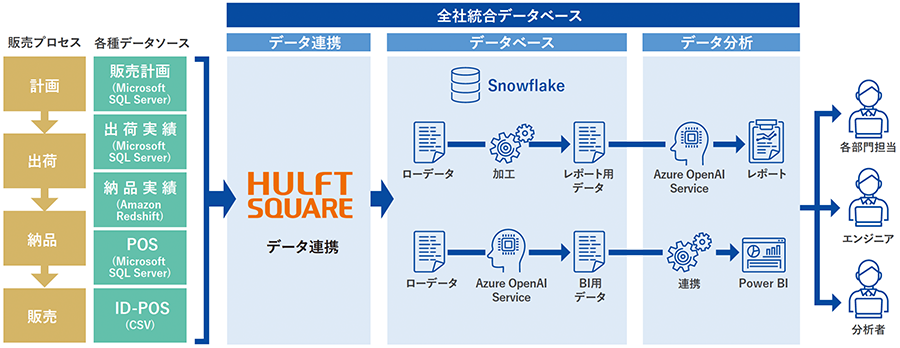
Currently, HULFT Square is used to collect data from SQL Server, where business system data is stored, and Amazon Redshift, a cloud DWH, and to act as a pipeline to Snowflake, a data storage DWH. HULFT Square has been used to build an interface for aggregating data into Snowflake from around 10 systems, mainly mission-critical system, core system, and as much as 20GB of data is exchanged daily. "We have been using HULFT to connect our internal human resources system to various systems internally for some time, so we connect it to HULFT Square via HULFT," explains Yamagata.
The data stored in Snowflake is viewed on-site primarily using Microsoft's Power BI, and the scope of data utilization is expanding. "In terms of Power BI, the number of in-house development users has increased by more than ten times in about six months, and the number of reports created has increased by more than three times. This increase shows that data utilization is progressing in a variety of situations," analyzes Itagaki. Power BI itself is also linked to systems other than Snowflake, and HULFT Square is contributing to revitalizing data utilization with Power BI.
The company introduced HULFT Square around 2022, initially starting with a dashboard that visualized the cost status of materials and demand to optimize material procurement. Since then, the company has steadily expanded the scope of data integration through collaboration with sales, marketing, and supply chain teams. Now, in addition to confirming sales figures and internal performance figures, including profits for each client, financial reports are visualized with Power BI and are used as an essential information source for discussions during meetings.
data integration /analysis platform is also being used in situations where generative AI is incorporated into data processing for business use, such as utilizing data accumulated in Snowflake and using generative AI in the background to output new insights. "We are also conducting testing to input unstructured data such as the results of product surveys into Snowflake, analyze it with generative AI, and provide the results of quantitative analysis to the marketing department. We plan to fully provide this as a product to the field in the near future," explains Yamagata. With regard to generative AI, it is being considered to enable members who are not familiar with the system to explore data in natural language, and to expand this to creative tasks such as considering actions to be taken after analysis. HULFT Square will be used for some of the data collection required for utilizing generative AI.
Previously, the process required downloading the necessary data from mission-critical system, core system using Excel, and then inputting and analyzing that data in Power BI, but now, by building Power BI using data collected in Snowflake from each system as the source, it is possible to view and analyze the data. "The time it took to input data into Power BI has been reduced by about 60% compared to before, and HULFT Square has been a great help in streamlining the process," says Yamagata.
data integration image
Another secondary benefit is that data has led to increased collaboration between departments, and the use of the same information source has reduced waste in the use of internal resources. "By consolidating previously scattered information, communication has been stimulated, and I have the impression that data is breaking down organizational barriers. data integration /analysis platform will also be useful in fostering the data-driven culture that we are aiming for," says Itagaki. HULFT Square is indeed contributing to the creation of an environment that aims to arm employees with data.
Regarding HULFT Square, the GUI makes it easy to implement data integration processes, and the wide range of connectors has dramatically improved the speed from initial testing to pulling data into the DWH. "In terms of stable operation, it works at a level that we don't even have to worry about, and we highly appreciate its stability as a high-quality service. Another benefit is that the data pipeline is stable, allowing us to allocate resources to checking specifications on mission-critical system, core system and designing data integration," says Yamagata. Although there were many opportunities to contact support at the start of the service, Yamagata also praised the support department's response, saying that the quick response and high-resolution answers made it easy to resolve issues.
Saison Technology not only uses HULFT Square for data integration, but also provides support for the company's internal use of generative AI, which Itagaki says was a major catalyst for promoting generative AI. "When I asked Saison Technology to share their efforts in utilizing generative AI within the company, they gladly accepted, and we had regular meetings to learn from them. Without this, I don't think we would have made this much progress in using generative AI," Itagaki says with appreciation. Yamagata adds, "They provided detailed guidance on how to visualize data and deliver it to users, including key points for building it, using examples from within the company. They were particularly helpful in providing feedback on the importance of formatting data properly before inputting it into generative AI. HULFT Square was also useful in verifying how to pull data in from upstream." Saison Technology's support and HULFT Square contributed to the company's goal of building a foundation for utilizing generative AI.
Outlook: We want to expand our data sources by further utilizing HULFT Square
As for the future, HULFT Square will be further utilized as data integration platform when expanding the data sources required for data analysis as requested by the field. We are looking forward to the horizontal development of this system as well," says Mr. Yamagata, "since it is simple to develop data input to the DWH. As for the areas of use, data utilization is expanding to include sales and marketing, as well as R&D areas such as materials and product development, and the company intends to continue to expand the system as a central platform for this purpose.
Itagaki says that utilization in the marketing field, where data analysis is particularly essential, will be a major point. "Until now, we in the systems department have had almost no contact with the marketing department, but since this is an area that requires data, this data integration /analysis platform is a perfect fit. We would like to continue to pull in the data that the marketing department needs into HULFT Square, and create an environment where data can be used more than ever before," says Itagaki enthusiastically.
Ultimately, they would like to create a world in which end-user business departments can freely access and utilize the data collected by HULFT Square and stored in Snowflake. "For example, if Power BI could be viewed directly during a meeting, it would eliminate the need for junior employees to create documents. Moreover, if all members, including superiors, were to come into contact with Power BI during meetings, it would also contribute to the development of digital talent. That is the kind of world I would like to create," said Itagaki, speaking about his future aspirations.
Nissin Foods Holdings Co., Ltd.
- Head office address: 1-1 Nishinakajima 4-chome, Yodogawa-ku, Osaka
- Established: September 4, 1948
- Capital: 25,122 million yen
- Number of employees: 16,509 (consolidated)
- Business activities: Formulating and promoting management strategies for the entire Nissin Foods Group, auditing group management, and other business management.
- The content of this case study is current as of the time of the interview. The content of this case study may change without notice.