

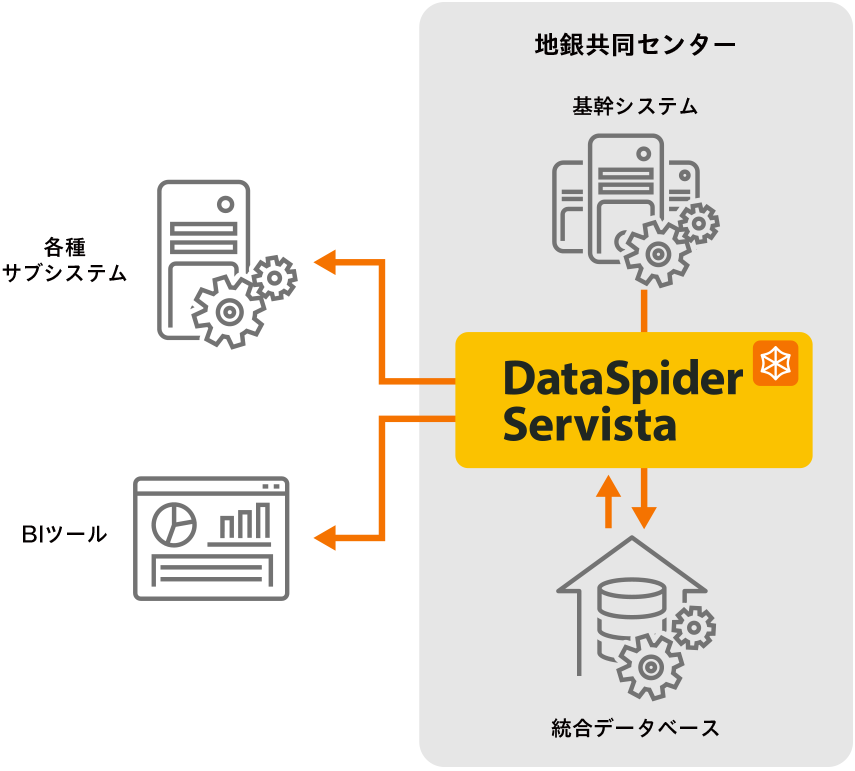
NTT DATA Corporation (hereinafter referred to as NTT DATA), which provides high-value-added IT services to financial institutions, has built and operates the Regional Bank Joint Center, which is used by 14 regional banks (as of the end of October 2020). This service provides an integrated information database system in addition to the core system, and has replaced the standard ETL* tool used to link the integrated database with various subsystems with DataSpider International from Saison Information Systems (now Saison Technology). This has successfully resolved issues with cost performance, functionality, and support that had existed with previous ETL tools.
- An abbreviation for Extract (extract data from external sources), Transform (convert and process the extracted data), and Load (load the transformed and processed data)
assignment
Upgrading the existing ETL tool will incur repair costs, and support is a concern as it is an overseas OSS.
Benefits of implementation

Compared to the original commercial ETL
License
Reasonable

Because it is a domestic ETL product
support
The face is safe

advance PoC
By implementing
A smooth transition
Background: Facing the hurdles of high costs for commercial ETL and weak support for OSS
The NTT DATA Regional Bank Joint Center (hereinafter referred to as the Regional Bank Joint Center) began providing services in January 2004 as Japan's largest joint core system center for regional banks and second-tier regional banks, using the cutting-edge banking application BeSTA *. In addition to the main core systems (accounting systems, foreign exchange systems, etc.), in 2011 the center also began providing integrated information systems, such as an integrated database that enables linkage with the subsystems operated by each bank for business management, marketing, etc. The level of service has been improved with each year's upgrades.
The Regional Bank Joint Center had previously adopted two software products for ETL, which links the core system, integrated database, and information subsystem. Initially, they introduced a commercial ETL product from an overseas vendor, but the license was expensive and the functionality was excessive, so they tried replacing it with an open-source overseas ETL tool. However, as it was an overseas OSS, it was not localized, which raised concerns about support. Furthermore, in order to accommodate the major future upgrades that had been announced, the linkage mechanisms that had been developed for each bank would have had to be revised, at great cost and time.

Second Financial Business Division Second Banking Business Department
Second Banking Division, Regional Bank Joint Development Section Manager
Ryohei Komine
Since the summer of 2018, the company has been considering replacing its existing ETL system with one that offers excellent cost performance and comprehensive support, and it was DataSpider International from Saison Information Systems (now Saison Technology) that caught their eye. "We were already using other products such as HULFT for various projects at our company, and after discussing various options, they introduced us to DataSpider International. Above all, it was a domestically produced ETL system, and we felt reassured knowing that Saison Information Systems (now Saison Technology) would be fine. We also appreciated the fact that it offered an easy-to-use UI on a par with the high-performance commercial ETL system we were initially using, but at an overwhelmingly low cost," says Ryohei Komine, manager of joint development with regional banks.
- Banking application engine for STandard Architecture. NTT DATA's vendor-independent standard banking application.
Conduct PoC at the introduction consideration stage to ensure smooth transition and development
Ultimately, the deciding factor in selecting DataSpider International was the PoC* that was carried out in an actual development environment. "We proposed conducting a verification test to determine whether or not a replacement was feasible within a limited timeframe, and they gladly accepted, and the migration project began moving forward with DataSpider International as the candidate," says Hashimoto.

Deputy Manager, Third Development Department, First System Development Division
Mr. Itsuki Hashimoto
In March 2019, DataSpider International was installed in the development environment where the OSS ETL was running, and comparisons were made to check whether the development processing of the interface implemented by the OSS could be performed in the same way (whether the specifications were met), whether the correct output could be produced when it was actually run, and what the resource usage was during that time, and the results were favorable. "We checked both a simple pattern with a large number of processes and a pattern with a small number of processes but a bit of an unusual feature, and we got the feeling that there were no problems with functionality as well as the number of output records, so it seemed like it would work. Only memory usage was quite different from the existing OSS, but we were told that this could be addressed by tuning DataSpider International. I think that being able to determine aspects that are difficult to understand on paper through PoC was a major factor in deciding to replace it with DataSpider International," says Hashimoto.
Thus, the decision was made to introduce DataSpider International in June 2019. A development project for the ETL migration began in July.
- Also known as proof of concept, proof of concept, or demonstration experiment, this is the act of verifying the feasibility of a new concept in advance.
DataSpider International usage image
Effect: Establish a stable service infrastructure to support customers' data utilization

Second Financial Business Headquarters, Second Banking Business Department, Deputy Manager, System Management
Daisuke Uchikoshi
This ETL replacement is part of a system upgrade for the "integrated database system," and together with hardware updates and software upgrades, the project took about a year from September 2019 to be completed in July of the following year, with the service now in operation as a full-scale commercial service. "During the development period, we carefully compared the current and new versions, so there were no issues such as different output results from before, and it is running without any problems. Our clients (regional banks) probably don't know what ETL is actually running behind the scenes, but the fact that we have created a platform that will allow us to provide a stable, high-quality service into the future is our greatest achievement as a service provider," says Uchikoshi.
In fact, system integration using DataSpider International is offered as an option, and many of the 14 banks that use the Regional Bank Joint Center have chosen not to adopt it due to the costs and labor required for migration, and instead continue to use their existing ETL tools and systems individually.
NTT DATA will encourage these customers to adopt collaboration options and promote the creation of a shared infrastructure for information systems, thereby pursuing customer benefits such as cost optimization and enhanced collaboration functions.
Furthermore, with the rapid decline in population and roughly half of regional banks experiencing losses in their core business, expectations are rising for strengthening sales capabilities through data utilization and creating new revenue models, and the bank plans to continue focusing on expanding its information services. "Sales promotion tools have recently become a hot topic among customers, and there is a growing awareness of 'offensive' strategies such as strengthening sales capabilities and improving profitability. I think that products like DataSpider International which have a wide range of adapters and can be connected to a variety of things, including cloud services, will become increasingly important in the future," says Komine.
- Download the case study leaflet
- Download "80 Selected HULFT Use Cases" - a collection of use cases for HULFT, DataSpider, etc.
NTT DATA Corporation
With the corporate philosophy of "using information technology to create new systems and values and contribute to the realization of a richer and more harmonious society," the company is expanding its system integration and network system service-related businesses globally in a wide range of fields, including public and social infrastructure, finance, and corporate solutions. As a global company with over 100,000 diverse employees working in over 50 countries, the company aims to realize business innovation by connecting various ideas and the latest technologies around the world.
- The content of this case study is current as of the time of the interview. The content of this case study may change without notice.