


Takeden Co., Ltd. was founded in 1959 in Asahi Ward, Osaka City. It is a general trading company specializing in electrical and residential construction materials, handling a wide range of products, from electrical equipment and materials such as LED lighting and air conditioning equipment to environmentally friendly, energy-saving products like solar power generation systems, as well as housing equipment and building materials. "Compared to other industries, our electrical construction materials industry has not been particularly IT-advanced. Even routine tasks require manual intervention, and we remain a labor-intensive industry with low productivity. We felt that it would be pointless for Takeden to reform alone, so we launched the 'Phoenix' project with an eye toward reforming the entire industry," says Katsuhisa Asakuno, general manager of the company's IT Planning and Development Department. We spoke to Takeden about "Phoenix," a large-scale project the company undertook as a whole, and the role HULFT-WebConnect (hereinafter referred to as WebConnect) played in this project.
Customer Issues
Establish a highly secure file transfer function between multiple companies while minimizing costs and effort
solution
- HULFT-WebConnect enables secure file transfer with multiple other companies
- Gained a foothold in automating ordering
Benefits of implementation

Order and placement data
Secure Transfer

With webEDI
Automate ordering and placement

Automate human work
More valuable
To work
The "reform" project took seven months to plan and five years to get up and running
"In 2012, Takeden changed its president, which led to a new vision. We were fortunate to celebrate our 60th anniversary in 2019, and set a new goal for the company to become a 100-year-old company in 40 years' time. To achieve this, we had to make effective use of IT and move away from a labor-intensive model. But was simply upgrading our IT system enough? We aimed for an IT system that could contribute to fundamental reform, and it took us seven months just to come up with the plan." (Mr. Asakuno)
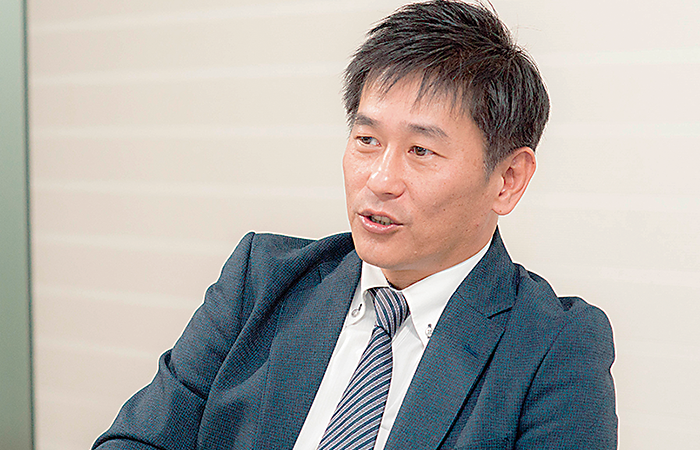
Katsuhisa Asakuno, Director of the IT Planning and Development Department
"Employees want a system that allows them to carry out their work conveniently. Of course, this is necessary in terms of improving work efficiency, but our goal is to build the foundation for achieving our vision," continues Asakuno. With this in mind, they launched a major project called "Phoenix" with 30 members selected from within the company.
"We also engaged an IT consultant, and we thoroughly investigated the future of Takeden, creating a 200-page vision document. In fact, there had been calls for reform for some time, but the project had been abandoned before it could be put into action. However, at the time, we only discussed the matter, and no further action was taken. We decided that now was the time to reform, including our IT systems," says Asakuno.
Asakuno continues, the wave of IT adoption in the electrical materials industry in which Takeden deals has been gradual, and many companies have viewed it as "not an urgent issue" because "it can be solved with human resources." Although they did not recognize it as a clear issue, he says, "they felt it was inconvenient" to have to manually enter orders received by phone or fax into a computer and check inventory.
"Is it enough to be able to input data quickly? Is it enough to be able to check inventory immediately? That is an improvement, but it is not a reform. In the first place, there is no need to input data. Everything from checking inventory to placing and receiving orders and issuing invoices is done automatically based on order data from customers. Reform is about fundamentally changing business processes," says Asakuno.
Adopted WebConnect, which had not been on the list of options
"To build this large-scale information infrastructure, we put forward our requests while getting feedback from IT vendors. While searching for a platform and middleware that would meet our requirements, we came across Saison Technology's HULFT-WebConnect" says Asakuno.
System configuration diagram using HULFT-WebConnect
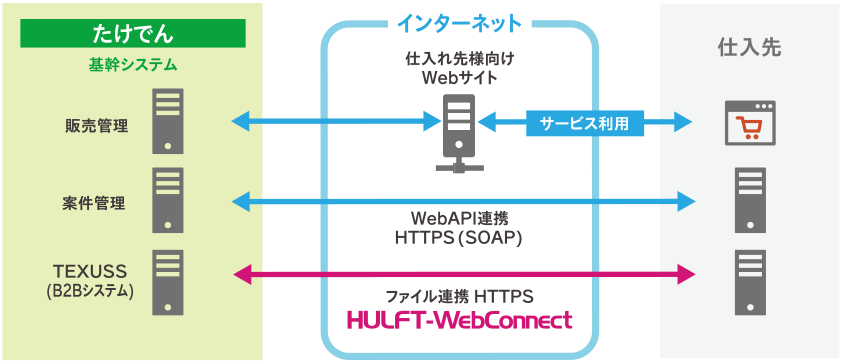
In fact, at the time, WebConnect was still in the development stage, preparing to launch the service. "To be honest, there were some concerns about availability and security," says Asakuno. However, the cost was low, and the technical hurdles to implementation were low - communication was possible without exposing the company's environment to the outside world, and the publishing process could be completed in a minimal amount of time - so the IT vendor advised them that "as long as the quality of the service can be guaranteed, it would be well worth using," and they decided to go with it.
In fact, about 25 years ago, there was a movement within the industry to realize EDI. However, at the time, office computers were mainstream and the Internet was not widespread, so the cost and technical hurdles to realization were high and it did not come to fruition. Then, when Windows-based PCs and the Internet began to be introduced into companies, manufacturers launched their own e-commerce sites and began to promote them in order to streamline operations such as order taking. However, agents had to understand and use the different operation methods and input rules of each manufacturer. In this situation, which took time and the burden was only increasing, Asakuno gathered 50 major manufacturers together and advocated for the goal of establishing the de facto standard for EDI using WebConnect in order to realize EDI with manufacturers.
"When we explained Phoenix to 50 of our major suppliers and asked them to cooperate, we explained that WebConnect does not require a large investment and has a low implementation burden. Above all, we spoke passionately about our desire to contribute to the development of the industry, and they all agreed to cooperate. Our company operates between manufacturers and the field, and we have hundreds of suppliers, both large and small, and we cannot set up dedicated lines with each company. IT literacy varies from company to company, so we cannot afford to cause them any inconvenience. We thought that if we could eliminate this issue, it would be a great benefit to the entire industry," says Asakuno.
WebConnect: Creating effective connections and protecting them
Currently, 60% of business partners have switched to Web-EDI. The biggest effect has been in the invoice issuance process; previously, after goods arrived, a person would check the purchase invoice against the order data and an operator would issue each invoice one by one, but now they have succeeded in automating over 80% of the process. "Unlike improvements, reforms are hard to understand even when explained. At first, many employees were confused, and many tried to repeat the previous invoice issuance procedures, but now they understand the meaning of 'invoices are not something you type out, but something you 'issue', and we have succeeded in reforming our operations," says Asakuno.
"The Phoenix project was a huge one that brought about reforms not only for our company but also for our suppliers," says Asakuno, revealing the intensity of the reforms he aims for. However, he continues, "However, after the project went live, our company alone was able to reduce work by 900 hours per month. We completed the project with a sense of mission that we were sure would bring these benefits to the entire industry."
"Takeden is always connecting people. WebConnect safely protects that connection. Thanks to it, we were able to get closer to the environment we wanted. We were also able to simultaneously improve our own productivity and customer satisfaction. Based on these achievements, we would like to lead the IT revolution in the industry." (Mr. Asakuno)
- Download the case study leaflet
- Download "80 Selected HULFT Use Cases" - a collection of use cases for HULFT, DataSpider, etc.
Takeden Co., Ltd.
Founded in 1959 in Asahi Ward, Osaka City as a wholesaler of electrical materials. Since its founding, the company has maintained its management philosophy of "starting with people, for people," and has continued to move forward alongside "people" as they change with the times. Now celebrating its 60th anniversary, the company has grown into a general trading company of electrical and building materials, and aims to become a "centennial company."
- The content of this case study is current as of the time of the interview. The content of this case study may change without notice.